

Jun Wang

This post was written just before Climate Week NYC 2024 and posted on LinkedIn:
https://www.linkedin.com/posts/jun-wang-9479152bb_9100-the-climate-week-nyc-2024-https-activity-7235376582851272706-a1Kw?utm_source=share&utm_medium=member_desktop
The Climate Week NYC 2024 (https://lnkd.in/e4dB7ZYY) is approaching soon. Plastic might be scrutinized under the climate lens again for its carbon footprint. However, as this paper (https://lnkd.in/ekTdap-4) points out, “the greatest threat to earth’s climate continues to be the rise in atmospheric CO2 from the combustion of fossil fuel emissions. There are simply insignificant emissions being released from plastic–carbon leaching when compared to those produced by incineration and the production of plastics, and more so, from other fossil fuel-combusting anthropogenic activities.” In other words, plastic is not a big contributor to the climate change, compared to the fossil fuels burning for energy, or the production of cement, etc.
However, plastic is facing more challenges in the environment pollution side. Plastic waste is ubiquitous and currently there are no efficient ways to deal with it. It is proposed to build a circularity for the plastic economy, i.e., to recycle the plastic waste and bring it back to new products, but there is a long way to go to build plastic circularity. Meanwhile, it is getting more and more clear that such a circularity in a perfect conceptual sense might never be achieved.
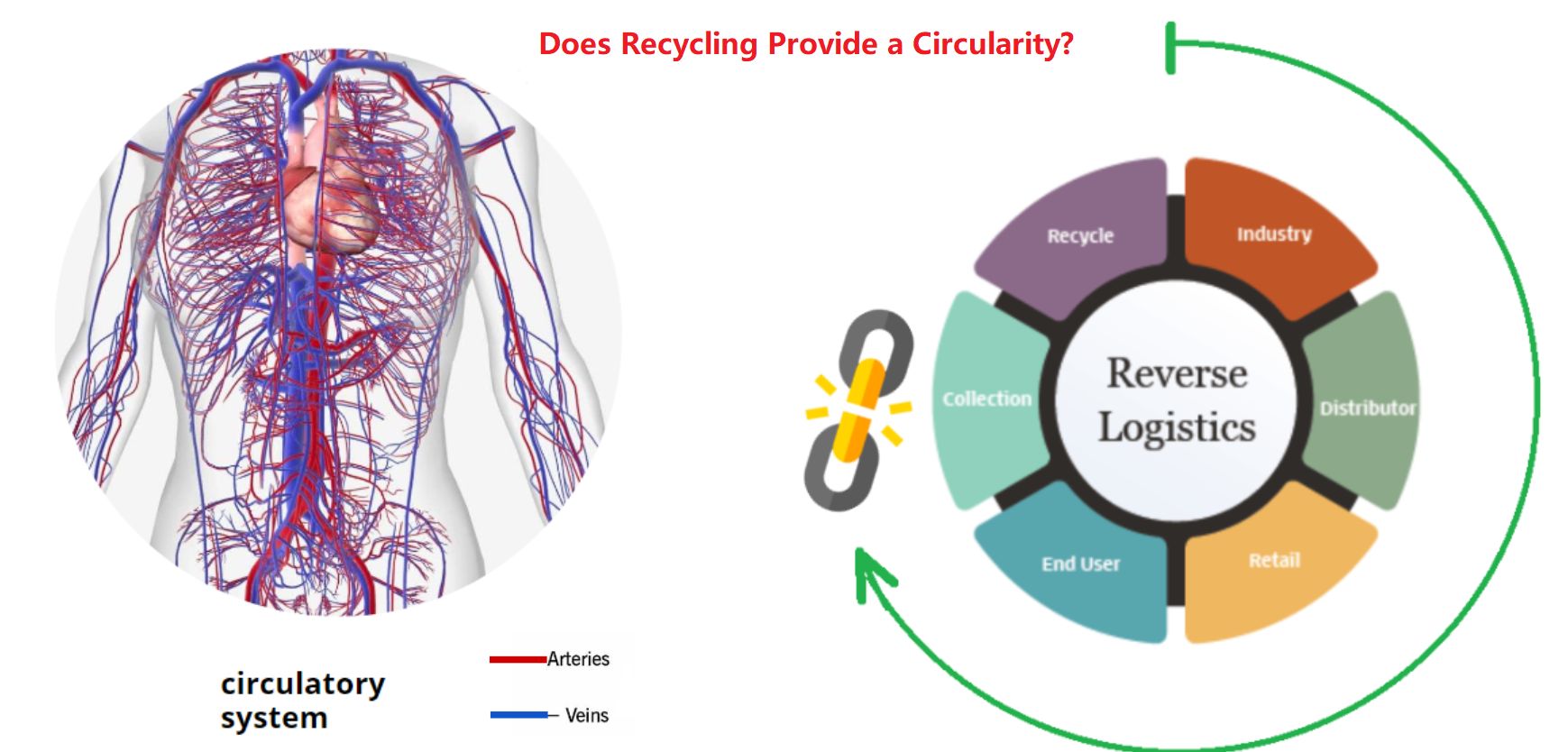
Human body presents a perfect circularity example – our circulatory system, in which blood goes through a forward artery network and a backward vein network. The two networks are equally complicate and fully built, which censure that the blood can circulate in our body in a perfectly balanced way. Compared to this system, plastic circularity is far from complete. Obviously there is a very strong forward logistic system, which can deliver the plastic products all the way to the individual consumer, as, if not more, complicated as/than the artery network; however, on the reverse logistic side, i.e., the waste collection and recycling side, unfortunately, it is very poorly built. There is a clear missing link in the plastic circularity. It needs a huge investment to build the infrastructure, whether it is worth doing so is another story.
So here is the question: Does plastic recycling provide a circularity? and how to get there?
Leave a Reply